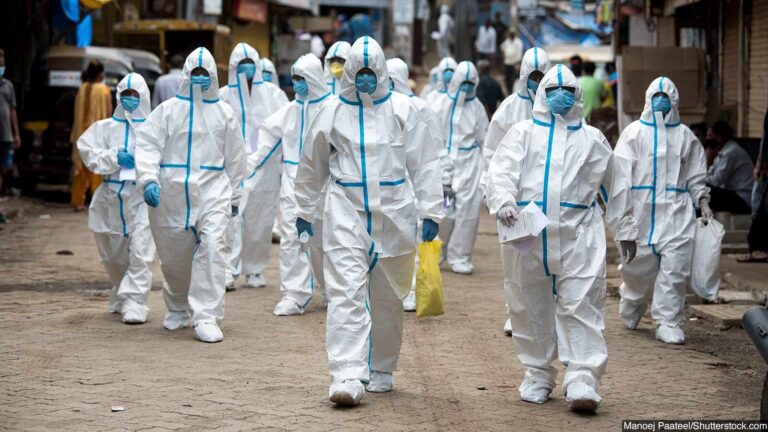
The ongoing conflict in the Middle East has triggered what the International Energy Agency describes as the largest oil supply disruption in history.
Sustainability frameworks have generally operated on an implicit assumption that the global system, while imperfect, is broadly stable. Trade routes and supply chains were treated as reliable backbones upon which climate ambition and ESG commitments could slowly be built.
With tensions disrupting critical routes like the Strait of Hormuz, which hosts nearly 25% of global seaborne oil trade flows, the world is witnessing a systemic shock to energy, trade, and sustainability systems. Oil prices have surged dramatically, with Brent crude touching $119–120 per barrel and recording one of the largest monthly spikes (~50%) in recent history. This energy crisis is a stress test for global sustainability frameworks.
- Around 20% of global oil and LNG flows are exposed to chokepoints like Hormuz
- Alternative routes (e.g., pipelines to the Red Sea) have limited capacity (3.5–5.5 million bpd)
- Shipping disruptions are forcing rerouting via longer routes, increasing costs and emissions
The ESG Blind Spot: Static Frameworks in a Volatile World
Traditional ESG frameworks have evolved significantly over the past decade, driving progress in emissions reduction, governance transparency, and social responsibility. However, they suffer from a dependence on stability in unstable times.
Most corporate sustainability strategies (although not their business strategies) assume stable access to energy and raw materials, focus on long-term targets without accounting for short-term shocks, and treat risks as environmental or regulatory but rarely geopolitical.
When oil supply disruptions remove millions of barrels per day from global markets, businesses are forced into reactive decisions often reverting to more carbon-intensive alternatives, delaying transition investments, or absorbing significant cost increases.
Companies committed to sustainability are structurally pushed away from their own goals during crises. In other words, sustainability strategies today are often directionally correct but operationally fragile.
The sustainability impact goes beyond corporate risks. As fuel prices rise, small businesses are forced to shut down and households need to ration energy. It triggers inflation, reduced mobility, and livelihood stress that additionally need to be accounted for in our social sustainability costs.
Embedding Geopolitical Risk: What Businesses Must Do
In order to incorporate this risk within corporate sustainability strategy, the NuSocia Sustainability Centre of Excellence highlights 5 pillars for businesses to build against geopolitical risk.
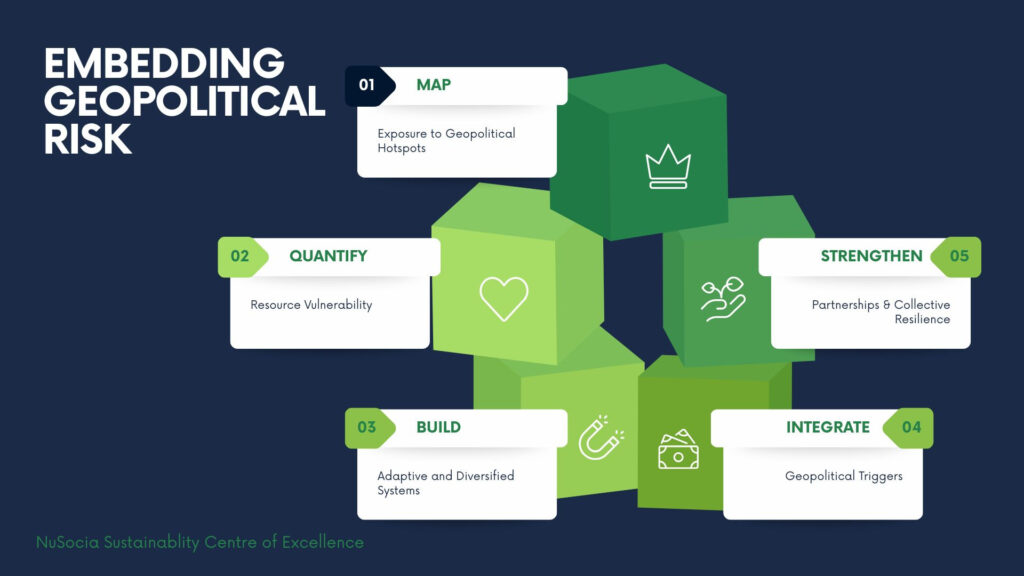
1. Map Exposure to Geopolitical Hotspots
Businesses must identify dependencies on high-risk regions and routes. This would allow them to map bottlenecks within their own systems. Prioritize from high impact to lowest to create an action list.
- Nearly 15% of global oil supply is currently trapped due to disruptions
- Asia receives ~80% of oil passing through Hormuz, making it highly vulnerable
Implication: Supply chains must be geopolitically mapped, not just operationally optimized.
2. Quantify Resource Vulnerability
During crises, energy shocks ripple across multiple industries including agriculture, manufacturing, food supply chains, and many more. Up to 6 million barrels of refining capacity in Asia may be impacted per day due to this crisis, creating a large disruption of all functions across the supply chain. Keeping the scale in mind, businesses must quantify their
- Raw material dependency: what is the amount of raw material that stands to be impacted.
- Example: Geopolitical Exposure Ratio: Calculate the percentage of critical raw material (CRM) sourcing originating from regions with a “High” or “Very High” risk rating (based on standard indices like the Global Peace Index or WGI), with a target reduction of 15% year-over-year through supplier diversification.
- Exposure to cascading supply chain risks: what sustainability metrics, costs, and environmental damage will result down the supply chain?
- Example: Carbon-Conflict Correlation Index: Measure the Greenhouse Gas (GHG) emission variance (Scope 3) caused by logistical rerouting or emergency air-freight necessitated by geopolitical disruptions (e.g., Red Sea shipping diversions).
- Energy cost sensitivity: if a disruption or a bottleneck occurs what would the cost be to their sustainability targets.
- Example: ESG-Risk Capital Allocation: Allocate a specific percentage (e.g., 5-10%) of the annual R&D budget specifically toward “circularity-as-de-risking”- quantifying the reduction in virgin material reliance as a direct hedge against geopolitical supply shocks.
3. Build Adaptive and Diversified Systems
Short-term responses (like reserve releases) are insufficient. Governments across the world released 400 million barrels from strategic reserves, yet prices remain elevated due to structural supply constraints.
Long-term business responses would include renewable energy integration (as a legitimate back-up rather than a slower long-term transition), decentralized energy systems, and strategies for circular supply chains.
4. Integrate Geopolitical Triggers into ESG Metrics
Sustainability frameworks must become dynamic systems that respond to triggers such as
- Oil price thresholds
- Shipping route disruptions
- Conflict escalation indicators
These triggers would inform ESG metrics that must evolve from reporting past performance to real-time decision dashboards. The tools to create these systems exist, however corporate data infrastructures need to ensure that data feeding and automation into real-time dashboards are streamlined. This will help them be one step ahead in their sustainability risk mitigation strategies.
To learn more about building your data infrastructure and automation roadmaps to be AI ready, reach out to our Head of Data & AI Center of Excellence: aviral@nusocia.com.
5. Strengthen Partnerships & Collective Resilience
No company can manage systemic risk alone. Energy crises now impact oil, gas, fertilizers, and even helium supply chains simultaneously. Current global coordination (e.g., IEA reserve release) is essential but reactive.
To truly mitigate risks and build resilience, cooperation and partnerships, before crises occur, become key. Corporates could engage with governments to build resilience in supply chains during crises, they could participate in industry coalitions with clear action plans and roles of responsibilities, and align with global energy transition pathways to ensure a streamlined approach.
Redefining Sustainability for a Volatile World
The current Middle East conflict is not an isolated disruption, energy systems have always been geopolitically fragile, supply chains have always been deeply interconnected and now it comes as no surprise that sustainability goals are constantly tested by external shocks.
Sustainability goals have to be prioritized and risk analyzed just as business goals are. They need to integrate geopolitical intelligence and be designed with adaptive, resilient systems.
At NuSocia’s Sustainability Centre of Excellence, we believe that sustainability is not just about reducing environmental impact but about building systems that can endure disruption while continuing to create value for people, planet, and business. To learn more about how to assess risk in your sustainability strategy and build mitigation plans for a resilient system, reach out to the Head of our Sustainability Center of excellence, namrata@nusocia.com.