

NuSocia AI & Data Center of Excellence | 2026
In September 2025, BCG published a report on what they called the widening AI value gap. The headline finding was stark: a small group of companies, roughly 5%, are pulling so far ahead on AI-driven returns that the gap with everyone else is a chasm. These future-built companies are 3.6 times ahead on three-year shareholder returns, 2.7 times ahead on return on invested capital, and generating value at a speed that compounds quarterly.
Most readers of that report will have thought: this is a corporate story. And they would be right, BCG wrote it for corporates. But reality is the same, if not harder, for social development actors. We need to prevent this fate for the organisations we trust to serve the people that markets have already left behind.
This article focuses on the NGOs, foundations, grassroots collectives, and government-adjacent agencies working with fragile data, overstretched staff, and tools that were never designed for them in the first place.
The Corporate Story and What It Actually Reveals
An influencer that keeps a pulse on the AI world, Vaibhav Sisinty, explains this gap through a comparison of Company A and Company B: it is not technology that determines who generates value, it is the discipline to go deep on a few critical workflows rather than spread thin across many.
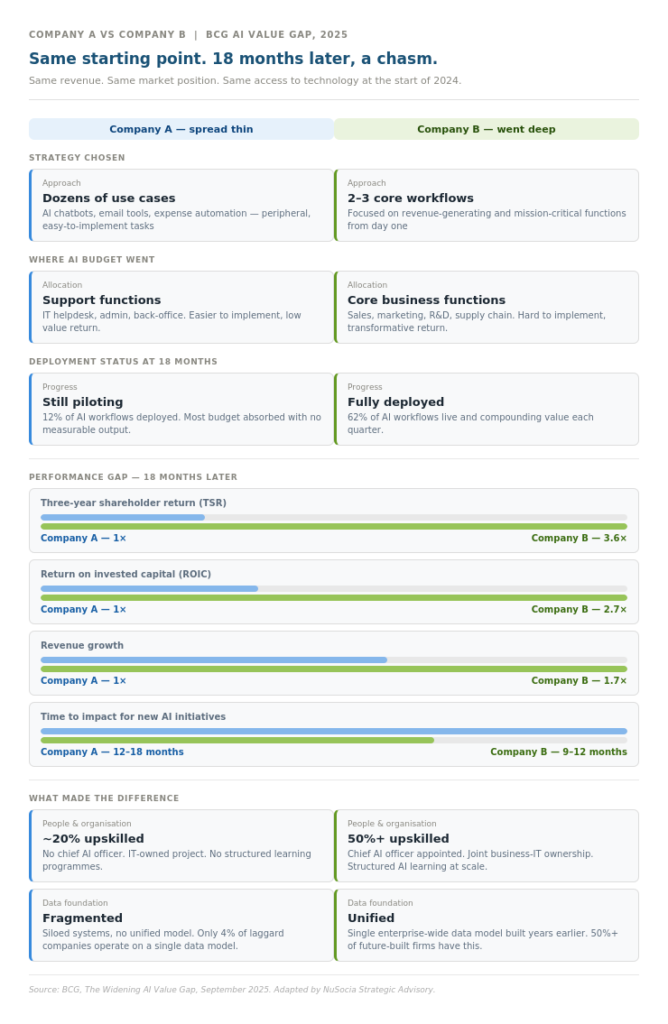
Substitute shareholder returns for community outcomes, and the same logic applies, but with higher stakes. For a development organisation, the question is not competitive advantage. It is whether it can serve beneficiaries better, faster, and with the evidence quality that keeps funders investing in the work.
The Social Sector’s Version of the Same Problem
While the global development conversation has fast-forwarded to AI agents and automation, most social sector organisations are still working out digitization and to a certain degree, automation. This is not a failure of ambition, but rather a predictable result of a technology ecosystem that has never designed for them.
| Four things the sector needs to understand1. The 10-20-70 rule BCG found 10% of AI value comes from algorithms, 20% from technology infrastructure, and 70% from people, processes, and organisational change. Most organisations obsess over model selection and ignore the 70%.The social sector already has the 70%: community engagement, staff capacity building, and participatory design are its operating culture. What it lacks is the foundational 20% that gives that investment traction. 2. What data infrastructure actually means here For a social sector organisation, a ‘unified data model’ are five decisions most organisations have never been supported to make: Where does beneficiary data live? How do field outputs connect to programme reporting? Where do KPIs sit and who can access them? Can a funder report be produced without rebuilding data from scratch? Is the Theory of Change tracked, not just stated?More than 50% of future-built firms operate on a single data model. Only 4% of stagnating organisations do. The winners started building in 2018–2020. The social sector needs to start now. 3. The trap of endless piloting 46% of companies experiment with AI; only 16% deploy it with tangible value. The social sector knows this cycle intimately: pilot a new tool, struggle with adoption, end the project, return to spreadsheets, repeat two years later.This is structural, not motivational. Pilots are funded by projects. Infrastructure is not. Donors fund outcomes, not the systems that make outcomes measurable. The only exit is going deep on a small number of workflows and holding that depth beyond project cycles. 4. Acceleration is possible, but requires a different starting point The social sector does not need to replicate the corporate journey. Its needs are more specific: a small NGO does not need a data lake: it needs to connect field data to its Theory of Change. A foundation does not need an AI orchestration layer: it needs to screen proposals without rebuilding the rubric each cycle.The acceleration pathway runs through specificity, not scale. Through tools designed for the sector’s actual workflows, not adapted from corporate templates. |
The Moves That Matter Now
For social sector organisations trying to navigate this landscape, the BCG framework — read through a development lens — points to three concrete moves.
First: Identify two or three core workflows and go deep.
Not everything, not all at once. The Company A trap is as available to NGOs as it is to multinationals. Identify the workflows most central to programme delivery and most costly in staff time — M&E reporting, grant proposal development, stakeholder communication. Pick two. Build the discipline to go deep on those first.
Second: Treat data governance as a programme investment, not an administrative cost.
Define — and document — where data lives, who owns it, and how it flows through the organisation. This does not require enterprise software. It requires decisions. Make them explicitly, with the same rigour applied to a Theory of Change.
Third: Demand that technology partners meet the sector where it is.
Generic AI tools dressed in development-sector language are not sector-appropriate solutions. The bar should be: does this tool understand our workflows without extensive configuration? Does it reduce the team’s cognitive load, or add to it? Was it built with practitioners, or merely for them?
| About Impact Cognition Impact Cognition is a suite of AI tools built specifically for the social sector — not adapted from corporate templates, but designed from the ground up with the rhythms, dilemmas, and workflows of nonprofit teams, grassroots organisations, and social entrepreneurs. Users can develop outcome-linked KPIs from logframes and Theories of Change, screen proposals against their own criteria, assess programme risk, distil complex research, and communicate impact — all through tools that understand M&E language, the tension between donor compliance and community voice, and the gap between impact story and impact evidence. The platform augments rather than replaces, translating complexity into clarity without flattening nuance. More tools are under development, built with direct practitioner feedback. |
This editorial draws on BCG’s The Widening AI Value Gap (September 2025) and the Impact Cognition platform introduction. It was developed by NuSocia Strategic Advisory as part of its ongoing work on knowledge infrastructure and technology adoption in the social development sector.