In India’s public health ecosystem, dozens of Accredited Social Health Activist (ASHA) worker applications are launched across states, yet few scale beyond a handful of districts. This raises a critical ecosystem question: When a CSR foundation, philanthropic funder, or state health department seeks to fund a digital pilot, what framework should they use to look beyond technical code and assess true systemic readiness?
NITI Aayog launched the Techno-Commercial Readiness and Market (TCRM) Matrix in July 2023 to assess technology maturity for Indian startups. The framework rates Technology Readiness Level (TRL), Commercialization Readiness Level (CRL), and Market Readiness Level (MRL) on scales of 1-9. However, a similar national framework is not yet widely available for the social sector.
To address this, we analyzed how the TCRM framework adapts to the social sector. By testing it against a hypothetical, AI-powered mobile application for ASHA workers, we identified where the national framework aligns with public health (social sector) needs, where it diverges, and how we can build a more resilient framework to help the ecosystem navigate the transition from isolated pilots to established Scale Highways.
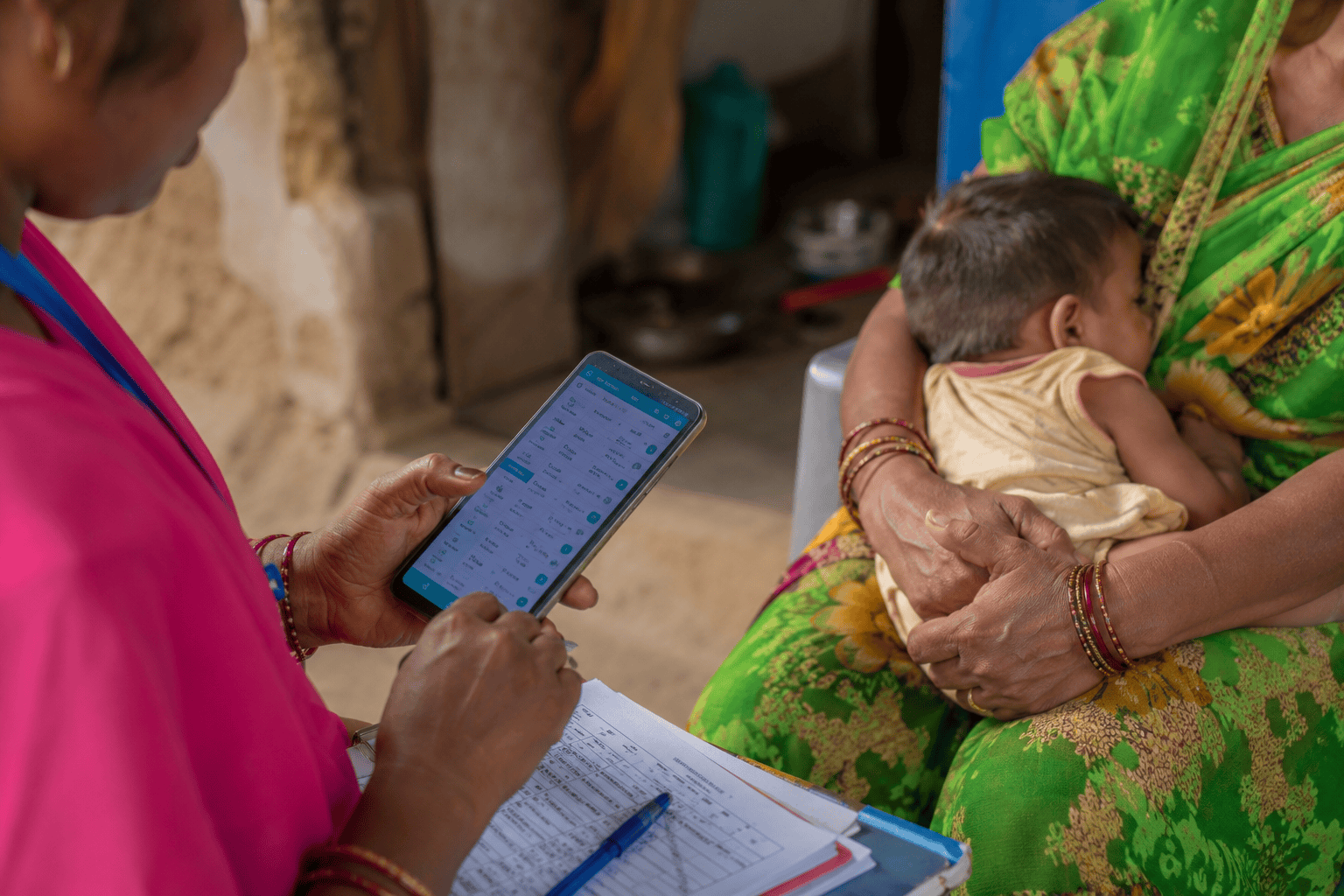
Consider a hypothetical AI-powered mobile application for ASHA workers. The app digitizes household registries, tracks pregnant women and children for immunization, calculates nutritional scores using mid-upper arm circumference, sends automated appointment reminders, and syncs data to the Ayushman Bharat Health and Wellness Centre portal.
Applying TCRM to this public health pilot reveals where the framework aligns with social sector needs and where it diverges.
TRL Assessment: Where TCRM Applies
Technology Readiness Level (TRL) assessments map directly onto the technical progression of the ASHA app, but the environment alters the definition of operational success.
- TRL 3 (Prototype): An offline-first mobile app is created and tested to verify that data capture works without internet connectivity, queuing data to sync when a network becomes available.
- TRL 5 (Real-World Validation): The prototype is validated on entry-level Android smartphones across diverse linguistic interfaces (Marathi, Tamil, and Hindi) using simulated household data.
- TRL 6 (Pilot Demonstration): The app is deployed with 50 ASHA workers in one block for 3 months, tracking 500 households to validate how the code handles real-world constraints like power outages and data-sync failures.
- TRL 7 (Workflow Integration): The system scales to 2–5 districts, integrating directly with hospital databases to pull patient schedules automatically without manual entry.
The Contextual Shift: While TRL 7 for a commercial enterprise might imply stable performance over a corporate Wi-Fi network, TRL 7 for a public health tool means the code must survive the realities of India’s last mile, operating over spotty 2G networks on low-end hardware, handled by users with varying degrees of digital literacy.
CRL Assessment: From Commercial Traction to Social Viability
Where the TCRM framework fundamentally diverges from social sector realities is in Commercialization Readiness. TCRM’s CRL measures viability via revenue generation, customer acquisition costs, and market share. Public health innovations/Social Sector Innovations, however, operate on a different ledger. They must clear Institutional Gates rather than commercial hurdles, measuring sustainability through government budgets, CSR allocations, or donor support.
To make CRL relevant, we must transition from commercial traction to Social Viability:
- CRL 3 (TCRM: Proof-of-Business Case vs. Social Viability): Instead of mapping monetization, we evaluate systemic efficiencies and cost-offsets. Does digitizing household registries reduce an ASHA worker’s administrative burden by 2 hours daily to enable 15% more home visits? Does preventing a single missed immunization save ₹10,000 in public healthcare treatment costs?
- CRL 5 (TCRM: MVP & Customer Acquisition vs. Adoption & Quality): Instead of paying users, success is measured by deep engagement metrics: an ASHA worker active adoption rate of 80%+ daily use, a data cleanliness score of 95%+ complete records, and minimized unit costs per household.
MRL Assessment: The Missing Dimension of System Readiness
Market Readiness Level (MRL) traditionally asks: Will customers buy this? What is the market size? Who is the competition? In public health, these questions miss the structural bottlenecks that cause innovations to stall. The primary risk is not market competition, but the Absorptive Capacity of state machinery. A public health application faces unique systemic barriers:
- Will the State Health Mission adopt this as the official tracking tool?
- Is the state procurement policy designed to onboard software-as-a-service (SaaS) health apps?
- Has the National Health Mission signed a Memorandum of Understanding (MoU) for open API integration?
- Does the app comply with the Ayushman Bharat Digital Mission (ABDM) Health Information Management System standards?
As documented in our previous article on scaling public systems, technology failure is rarely why social programs stall; the roadblocks are almost always policy alignment, rigid procurement structures, and institutional readiness gaps. A new app enters a crowded primary healthcare space where state governments have already invested heavily in legacy platforms. The ultimate question is not “Will they buy it?”, but “Can the existing public health infrastructure absorb it without forcing ASHA workers to manage multiple redundant applications?”
Beneficiary Safeguards: The Critical Risk Variable
While TCRM emphasizes risk mitigation for intellectual property and financial loss, it does not account for beneficiary-level harms. In public health tech, the stakes are profoundly human. A faulty recommendation engine in a commercial app results in a lost sale; a faulty algorithmic score in public health can lead to a missed medical intervention.
An adapted framework must integrate explicit cross-cutting safeguards:
- Data Privacy & Legal Compliance: Strict adherence to the Digital Personal Data Protection (DPDP) Act, 2023, and the National Health Policy (NHP) 2017 digital guidelines for handling sensitive household metrics.
- Informed Consent Architecture: Designing non-literate or multi-modal consent workflows so vulnerable populations understand how their health metrics are captured and utilized.
- Algorithmic Bias Audits: Ensuring automated diagnostic features such as computer-vision-based nutritional scoring—do not disproportionately misclassify or neglect children from marginalized communities.
- Graded Liability & Human-in-the-Loop: Establishing clear protocols where ASHA workers can override automated alerts based on localized, contextual knowledge, defining exactly where algorithmic guidance ends and human accountability begins.
- Resilient Infrastructure: Ensuring true offline-first capability for 48+ hours to remain functional in zero-connectivity pockets.
Co-Developing an Ecosystem Framework
To bridge these gaps, we are adapting the TCRM matrix into a framework tailored specifically for social sector investments. Our goal is to provide CSR foundations, Civil Society Organizations (CSOs), and government departments with an objective, standardized tool to evaluate technology before funding pilots.
The adapted framework restructures the original matrix around three pillars: Social Viability, System Readiness, and Beneficiary Safeguards.
Because a framework for the public good should be shaped by the ecosystem itself, we want to integrate your field experiences:
- Have you deployed TCRM or alternative readiness frameworks within social development programs?
- What specific policy or procurement challenges have stalled your technology from scaling?
- What dimensions are missing from current evaluation models that you believe are non-negotiable for public systems?
Join us in creating this framework
We invite tech-for-good founders, CSR leaders, and public policy practitioners to help us refine and co-develop this matrix. To view a copy of our latest draft of the framework and to contribute your insights, share case studies reach out to our team at nilakshi@nusocia.com or research@nusocia.com