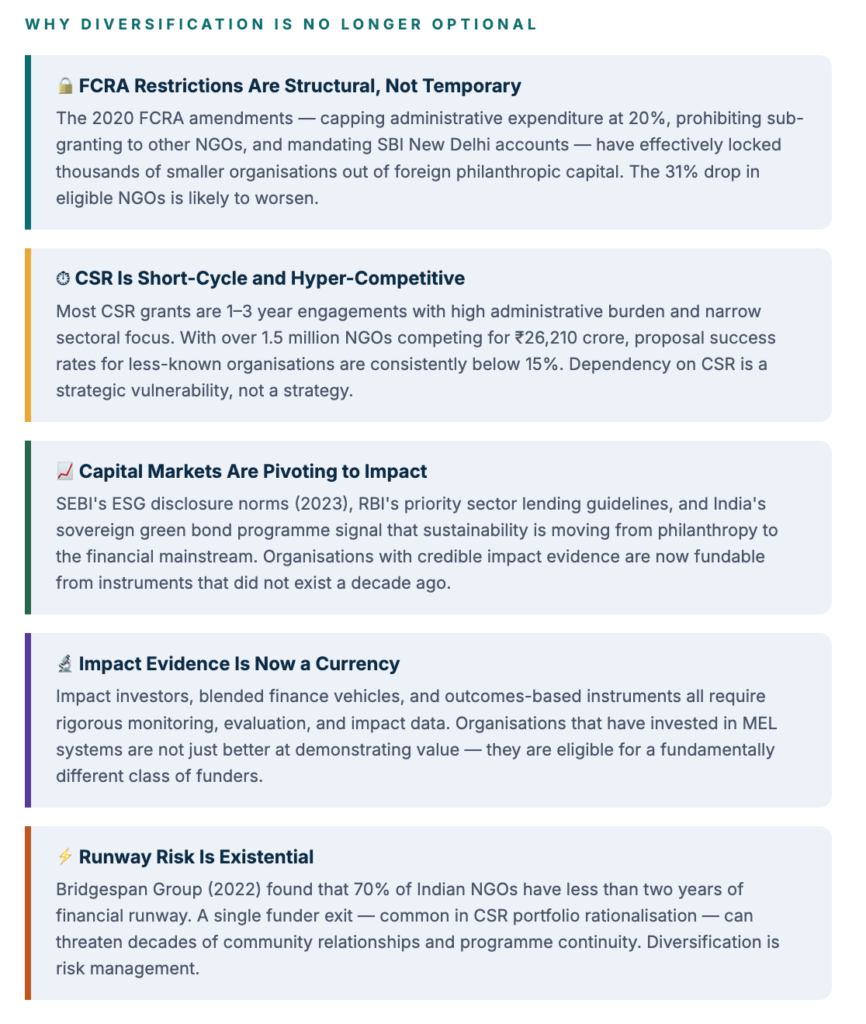

Since the Companies Act, 2013 made CSR mandatory, it has channelled thousands of crores into education, healthcare, livelihoods, and rural development. For most nonprofits, it’s now the default source of institutional funding. For corporations, it’s evolved from a compliance line-item into a genuine trust-building exercise.
But as India chases developed-economy status while confronting climate change, water stress, urbanisation, and jobless growth, funding diversity will matter more.
The Concentration Problem
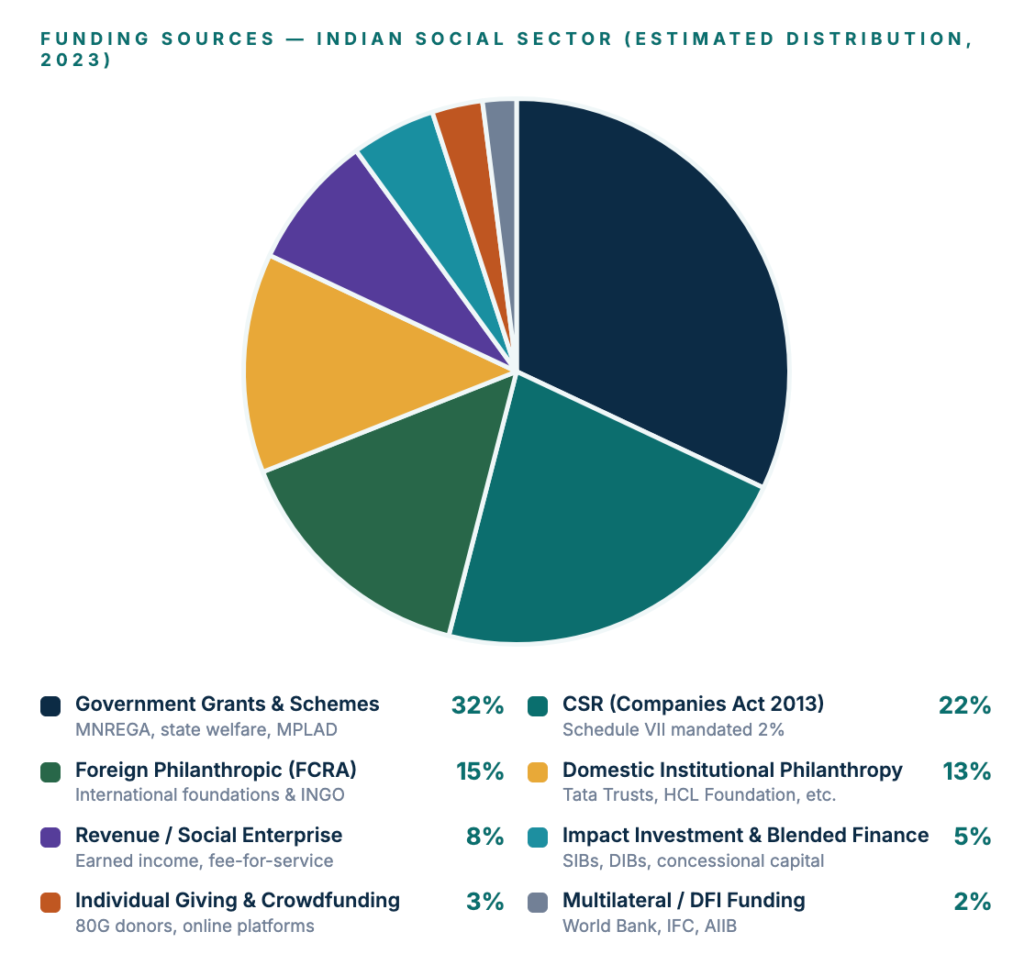
Source: Ministry of Corporate Affairs
Data from the Ministry of Corporate Affairs and Ministry of Home Affairs maps India’s social sector funding across roughly eight streams. Three of them — government grants, CSR, and FCRA — account for an estimated 69% of all sector funding. The remaining five streams, which include some of the fastest-growing financing instruments globally, share what’s left.
That concentration is the risk. Even though Government funding shall continue to remain as the most prominent one, it will face fiscal limits in a developing country. Traditional philanthropy has a ceiling. International development assistance isn’t scaling to meet the gap. Development, increasingly, will need to attract capital, not just receive grants.
That’s where sustainable finance comes in.
What “Sustainable Finance” Actually Means
The term started in environmental economics — green bonds, carbon markets, climate adaptation funds. It’s since broadened considerably. In this article, we use the definition as
“Financial instruments, structures, and mechanisms that deliberately mobilise capital toward measurable long-term social, environmental, or governance outcomes while maintaining or improving the financial viability of the organisation delivering them.”
Crucially, this isn’t “grants with a social purpose” rebranded. It spans debt, equity, guarantees, and outcomes-based payments — the full capital-markets toolkit, applied with intent.
The Financing Opportunities Worth Knowing
Social and Development Impact Bonds (SIBs/DIBs). Investors fund a social programme upfront and are repaid, with a return, only if agreed outcomes are achieved. Government pays out in a SIB; a donor or foundation does in a DIB. India’s first SIB launched in Rajasthan in 2015 for child education outcomes; Instiglio India and the British Asian Trust’s girls’ education DIB are more recent examples. Entry requires credible MEL systems and pre-agreed, measurable outcome metrics — this instrument rewards organisations that already track results rigorously.
Blended finance. Concessional capital — grants, below-market loans, first-loss guarantees — absorbs early risks so that commercial capital can follow. The IFC estimates every $1 of blended finance in South Asia crowds in roughly $4 of commercial capital. In practice, this looks like first-loss guarantees, concessional loans, technical assistance facilities, and co-investment structures. Access typically runs through intermediaries: Aga Khan Foundation, Michael & Susan Dell Foundation, Omidyar Network, and now NaBFID.
The National Social Stock Exchange (NSSE). Launched under SEBI in 2023, this lets nonprofits and social enterprises raise capital from public and institutional investors — through Zero Coupon Zero Principal bonds, equity/quasi-equity for hybrid enterprises, and dedicated Social Impact Funds. It’s a structural signal: social finance is being folded into mainstream capital markets, not kept at arm’s length as pure philanthropy.
ESG-linked corporate partnerships. SEBI’s BRSR mandate — applicable to India’s top 1,000 listed companies since FY2022–23 — has created real demand for verified social and environmental data, especially around Scope 3 emissions and supply-chain compliance. This opens a different kind of partnership: not CSR compliance, but organisations supplying the impact measurement and community engagement expertise corporates need for their own disclosures.
Green and social bonds. India’s sovereign green bond programme raised ₹16,000 crore in FY2022–23, mostly for infrastructure — but it signals a maturing market. For large, financially stable organisations with verifiable outcomes in water, renewable energy, or sanitation, bond issuance is becoming a realistic long-term option, provided outcomes can be independently verified.
Community-based and diaspora finance. Two underused streams. India’s SHG federation movement — over 12 million SHGs, 130 million member households — is the largest of its kind globally and increasingly functions as quasi-financial infrastructure. Separately, India receives roughly $125 billion in annual remittances, a growing share of it is philanthropic. Organisations building real diaspora engagement — via GiveIndia, the Charities Aid Foundation’s Indian operations, or direct networks — tap funding that’s often multi-year and less encumbered by regulatory complexity.
From Grant-Ready to Investment-Ready
This doesn’t mean every nonprofit needs to chase investment or issue instruments. It means building the kind of credibility that reassures funders of every kind — CSR teams, impact investors, and public markets alike.
That credibility rests on familiar fundamentals: strong governance, transparent finances, real MEL systems, clear theories of change, independent impact assessments, and sustainability planning that goes beyond the next funding cycle. These have now become table stakes.
Evidence Is the New Currency
Impact assessments used to be a closing exercise, a proof, after the fact, that money was spent responsibly. They’re now the thing that unlocks capital in the first place.
Whether the ask is CSR renewal, blended finance, or an NSSE listing, the underlying question of proof doesn’t: can you show measurable change?
This is why MEL and data systems belong at the centre of organisational strategy — not at the compliance periphery.
What This Means Going Forward
CSR isn’t going anywhere — it remains one of India’s most important channels for corporate participation in development. But it’s no longer the whole picture. The sector’s future runs through an ecosystem where philanthropy, public finance, private capital, and capital markets operate together.
The organisations best placed for the next decade will be the ones that paired programme delivery with governance, evidence, and readiness long before the capital came looking for them.