
Women’s health is often discussed as a set of isolated biological events: puberty, pregnancy, delivery, menopause.
While these investments towards these milestones have historically driven improvements in localized metrics, this approach fundamentally misunderstands how human health operates.
Women’s health operates as a loop
What happens in childhood shapes adolescence.
What happens in adolescence shapes the biological and psychological foundation of reproductive years.
What happens in reproductive years shapes midlife and chronic disease risk.
And what happens in midlife shapes ageing, frailty, disability, and dependence.
That is why the life-course approach matters. It helps us see that women’s health is not only about maternal care or one-time service delivery. It is about cumulative risk, persistent disadvantage, and the systems that either reduce or reinforce them.
Treating women’s health as a mere clinical category ignores the compounding nature of risk. The World Health Organization’s capability approach highlights that women’s health and well-being depend not just on medical care, but on substantive freedoms and agency i.e the freedom “to be” and “to do” . These freedoms are relentlessly shaped by caste, class, geography, disability, and prevailing social norms across every stage of life.
Investing Across the Life-Course Trajectory
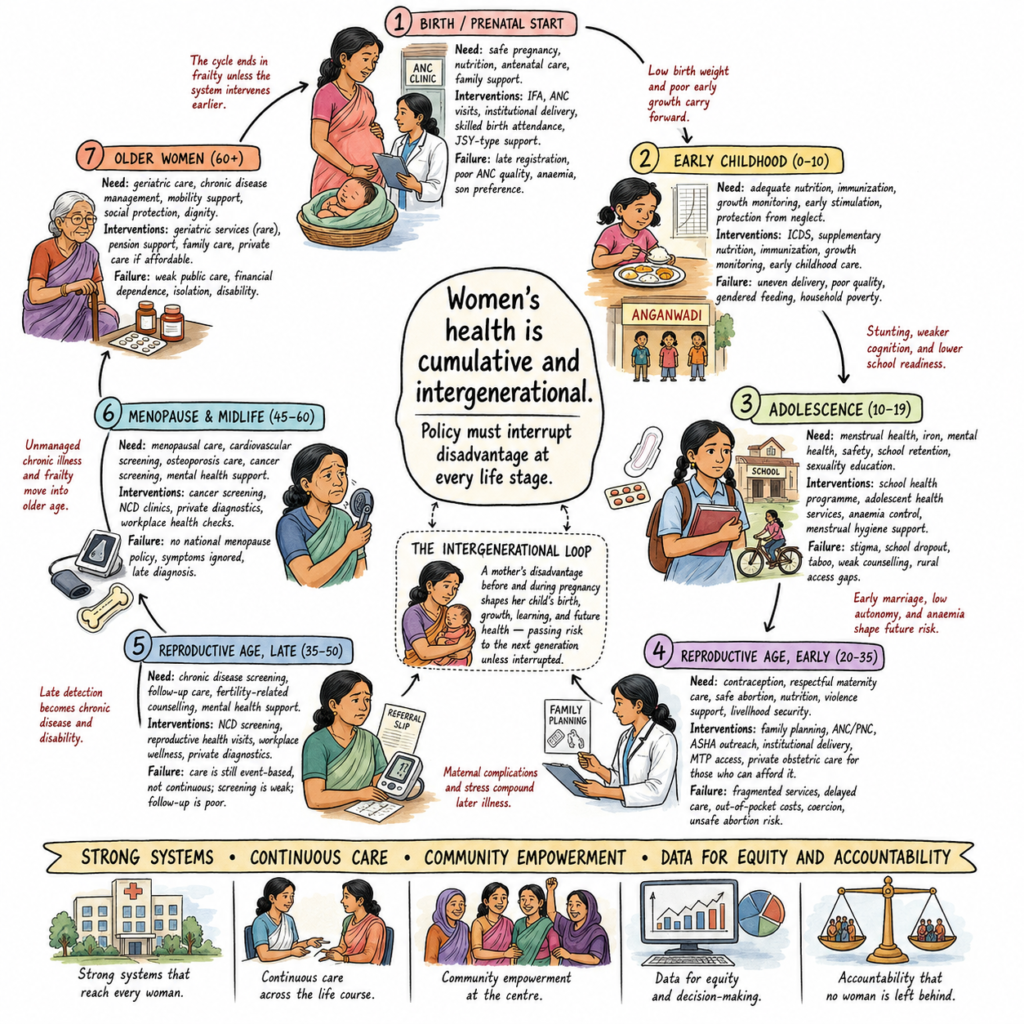
A life-course approach clarifies that investments cannot be siloed. Each biological phase is an investment gateway that mitigates future clinical and financial burdens.
Childhood and Adolescence
- Adolescence shapes lifelong health and autonomy, yet young women are often underserved. In India, 59% of adolescent girls suffer from anaemia—a crisis driven by poverty and social inequities that perpetuates intergenerational disadvantage. Additionally, mental health is severely underfunded despite high depression rates among women. Targeted investments in school nutrition, peer support, and digital tele-psychiatry can interrupt this cycle early and build long-term resilience.
Reproductive Years
- While maternal care has historically received strong backing, reproductive health must extend beyond basic delivery. Pregnancy often uncovers underlying risks for chronic conditions like cardiovascular disease and diabetes. Integrating non-communicable disease screening into routine prenatal care using digital registries and AI diagnostics ensures continuous, comprehensive management rather than reactive emergency interventions.
Midlife
- Non-communicable diseases now account for 60% of female mortality in India, yet midlife care remains underfunded. Issues like menopause receive minimal philanthropic capital, and cancer screening rates remain critically low at around 2%. Tech-enabled community screening platforms demonstrate that accessible, early detection can transform midlife care from invisible decline into proactive intervention.
Ageing and Late Adulthood
- In older age, cumulative life-course disadvantages lead to high rates of multimorbidity and financial vulnerability. Because older women often outlive men with fewer financial assets and less insurance coverage, medical costs frequently cause severe hardship. Capital investments must prioritize integrated long-term care, geriatric services, and financial literacy to support women throughout late adulthood.
Redesigning CSR and Private Capital Strategies
Women’s health is a highly lucrative macroeconomic lever. Today, the traditional definition of women’s health (primarily reproductive health and women-specific conditions) represents a $195 to $205 billion market globally. However, when utilizing a broader definition that includes conditions affecting women differently across their entire life cycle (such as cardiovascular disease, autoimmune conditions, and mental health), the industry represents a $430 to $440 billion global market. Addressing systemic care delivery failures could avert tens of thousands of adverse medical events and unlock up to $1 trillion in global GDP annually by 2040.
The problem is not just that women’s health is underfunded.
It is that it is often funded too narrowly.
Too much attention goes to single service points and superficial metrics, while too little is allocated to continuity, referrals, and resilient system design. To correct this, investors and CSR leaders must adopt the following systemic shifts.
| Traditional Investment Paradigm | Life-Course Investment Paradigm |
| Fragmented Health Camps: Funding isolated diagnostic camps (e.g., a one-day anaemia or cancer screening event) with no follow-up mechanism. | Primary Care Strengthening: Equipping existing sub-centers with digital registries and training frontline workers to ensure longitudinal follow-up and chronic care management. |
| Siloed Funding Streams: Allocating capital exclusively to maternal survival while ignoring the rise of non-communicable and mental health diseases. | Integrated Health Hubs: Financing facilities that handle multiple service dimensions—maternal care, menopause management, NCD screening, and mental health—in a single visit. |
| Input-Based Measurement: Defining CSR success by the volume of capital spent or the number of generic awareness sessions conducted. | Blended and Outcomes-Based Finance: Utilizing social impact bonds where private capital takes the upfront risk, and returns are generated upon achieving sustained, verifiable health outcomes. |
To build a world with healthier women, the global funding apparatus must stop treating women’s health as a momentary clinical category. It is an unbroken life course. Serious, transformative investment begins when private capital aligns with this trajectory, strengthening the systems that connect childhood nutrition to adolescent autonomy, reproductive safety to midlife resilience, and chronic care to a dignified old age. By financing the continuum of care, investors not only interrupt persistent disadvantage but they also build the architectural foundation for generational economic prosperity.
For investors, philanthropists, CSR leaders, and policymakers, this changes the question.
The question is no longer:
“Which women’s health issue should we fund?”
It becomes:
“Where in the life course are we intervening, what disadvantage are we interrupting, and what system are we strengthening?”