
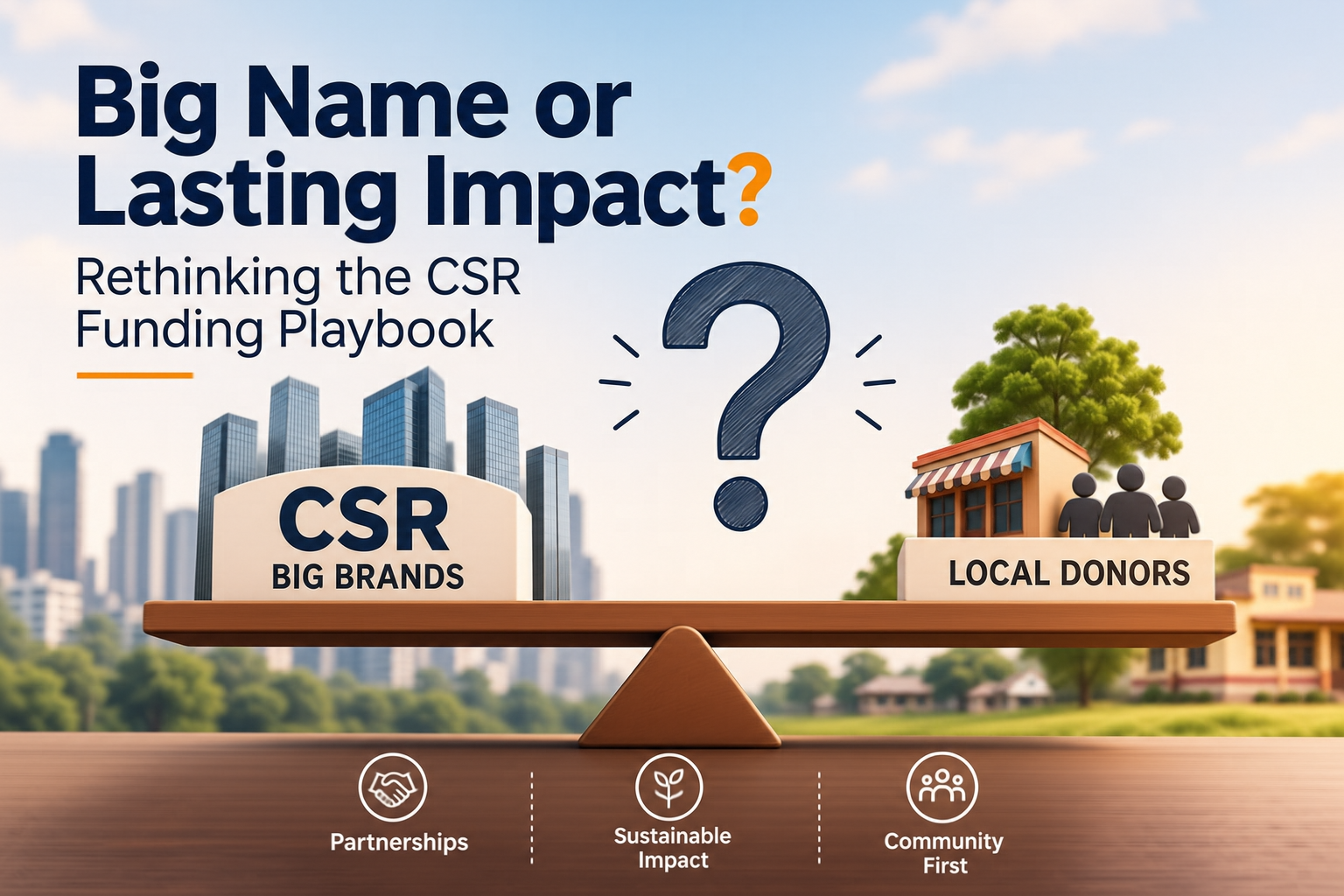
Fundraisers chase the biggest CSR names since that’s where the largest pool of money is. The money behind those names is not always the money that lets a programme last, according to new data.
Nonprofits rarely choose which funders to pursue on a single criterion. They weigh thematic fit, geographic overlap with a company’s operations, the likely size and duration of a grant, the reporting burden that comes with it, and the relationships they already have. Among these considerations, one tends to carry more weight than it is usually given credit for: how well known the funder’s name is.
The harder question is whether that value is being priced correctly: what an organisation gains from a prominent name, what it gives up to get one, and whether the money attached to the name is the kind that allows a programme to last.
Why the big name is a reasonable bet
The case for going after the largest CSR budgets is easy to make. Sattva Consulting’s State of CSR in India Report 2025 estimates that companies have deployed more than ₹2.2 lakh crore in CSR between FY 2014–15 and FY 2023–24, with annual growth holding at 12 to 15 percent. That money is not spread evenly. The same report finds that 2 percent of Indian companies, those with annual CSR budgets above ₹50 crore, account for more than 52 percent of Indian CSR.
If you run a lean fundraising team with limited hours, going where the money is concentrated looks like sensible prioritisation. Half the pool sits with a small number of boardrooms. Of course those are the doors people knock on.
The large names also offer something beyond the cheque. A partnership with a well-known company can carry a programme into rooms it would not otherwise enter. Co-funders take comfort in following a recognised lead. For organisations working on themes that are hard to explain, a big partner makes the work legible.
So the chase is not vanity, or not only vanity. It rests on a reasonable belief that scale and visibility will compound.
What the money actually does
The trouble is that a large budget on paper is not the same as money available to a particular programme in a particular year. Analysis of the same CSR data, notes that larger companies are more likely to carry unspent balances, while companies with CSR budgets under ₹1 crore are more likely to spend beyond what the law requires. The authors are careful to say this is not necessarily about intent. Deploying large pools of capital across many geographies and partners is operationally hard.
That caution is fair. From the nonprofit’s side of the table, though, the effect looks much the same whatever the reason. Organisations that build their year around a large name often spend it waiting: for approvals, for board cycles, for a strategy refresh, for the next financial year.
The competition at the top is also changing. Sattva’s report finds that non-NGO partners such as hospitals, universities, incubators and similar specialised institutions now account for 13.4 percent of CSR spend routed through implementation partners. It also notes that more than 60 percent of companies with CSR budgets above ₹10 crore rely on their own foundations for high-value programmes. A nonprofit pitching to the largest companies is often competing with the company’s own implementation arm, and with institutions that already bring scale and governance structures. The logo on the slide may be further out of reach than it looks.
The money nobody puts on the slide
Meanwhile, a different kind of money is growing with much less attention. The IDR analysis of this CSR data reports that in 2023–24, more than 380 companies with no legal CSR obligation chose to spend anyway, contributing close to ₹800 crore between them. Sattva’s report shows CSR moving beyond the metros too: tier-2 cities and industrial clusters now absorb 19 to 22 percent of district-level CSR, a share that has grown by 120 percent over three years.
Much of this is proximate money. A mid-sized manufacturer funds the school near its plant, the health centre its workers’ families use, and the livelihood programme in the villages around its gate. These funders rarely make anyone’s target list. Their names mean little outside the district. SME’s donors, therefore, are a reliable donor segment for several local causes.
What they can offer is harder to buy from a large funder: sustained attention. A company whose factory is two kilometres from the school it supports has its own reasons to keep showing up. Its leadership may know the headmaster. It is likely to care about the same outcome five years from now, because it will still be there. That kind of continuity never appears in a proposal as a line item, but programme teams know what it is worth.
The romance of small money
It would be easy to flip the argument and declare that the sector should stop chasing big names and embrace the small, loyal funder instead. That would be its own simplification.
Small money has costs. Ten funders giving ₹20 lakh each means ten due-diligence processes, ten reporting formats, ten relationships and ten sets of expectations. For a three-person development team, that can be more draining than one large grant. Smaller funders can also be idiosyncratic. Priorities may rest on one promoter’s interests, which can shift with a generational handover or a bad quarter. And proximity cuts both ways. If CSR follows corporate geography, regions with few companies, much of the Northeast among them, will not be rescued by mid-sized funders either.
Some work genuinely needs scale. A state-wide health systems programme or a large skilling effort may not be fundable through a combination of small cheques.
So the honest version of the question is not big versus small. It is closer to: what kind of money fits the kind of work we are trying to do, and are we choosing funders on that basis, or on how they will look on the slide?
What the chase does to us
The harder part of this conversation is internal. When an organisation spends years pursuing a particular kind of funder, it slowly becomes the kind of organisation that funder would fund. Programmes get reframed to fit business priorities. Timelines compress to match reporting cycles. The theory of change acquires a shorter horizon.
There is a difference between an organisation that shapes the funding conversation around the length of its work and one that, without quite noticing, shapes its work around the length of its funding.
A different slide
It is worth imagining what that funder slide might look like if it were arranged differently. Instead of a grid of logos sized by brand recognition, perhaps a list sorted by how many years each funder has stayed. Perhaps a column showing who paid for the things nobody else would: salaries, data systems, the second year of a pilot that was not yet working.
That slide would probably look less impressive to an outsider. Some of the names on it would mean nothing beyond the district. It might also be a more accurate picture of what is actually holding the organisation up.
None of this answers the question cleanly, but it helps build the questioning of who and why. Once a funder matches the true criteria of the program, then the NGO and implementation partner can truly co-build lasting change.
Sources
- Sattva Consulting and India Data Insights, CSR’s Next Act: How the Coming Decade Will Redefine Corporate Impact (State of CSR in India Report, 7th edition), October 2025. Analysis based on Ministry of Corporate Affairs CSR data.
- Shruti Bharath and Tushti Chakraborty, “The new logic of CSR funding in India”, India Development Review, June 2026.
- NuSocia, “Small is not always Beautiful: How MSMEs in India are facing COVID19 Scenario”, NuSocia blog, April 2020. https://nusocia.com/small-is-not-always-beautiful/