Why the social programmes we fund must be designed for the climate people actually live in, and five questions that can help.
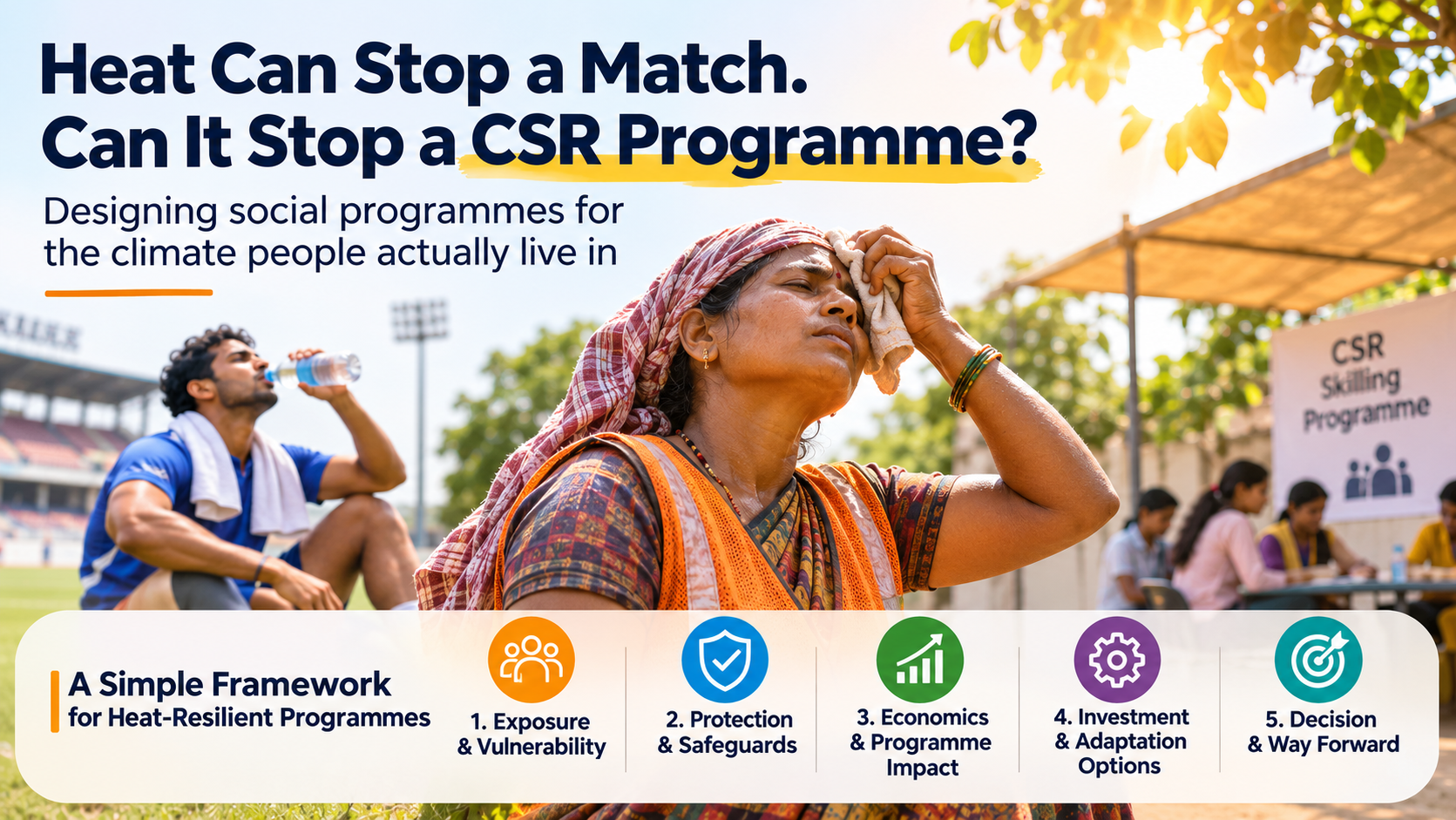
An athlete competing in extreme heat is surrounded by safeguards: hydration protocols, mandatory breaks, medical teams, heat monitoring, cooling equipment, modified schedules and, crucially, rules that allow competition to stop.
A construction worker, street vendor, agricultural worker or waste worker may face the same physiological stress, but have far fewer options to stop working without losing income. WHO now explicitly identifies both outdoor workers and athletes/exercising people as groups disproportionately exposed to extreme heat.
Do they have the same protection? Can they stop without losing income, missing a training session or compromising a programme target?
A gap in how we respond to heat
The comparison is striking because it reveals a gap in how we respond to heat. In some settings, heat is recognised as a risk that requires protocols and adjustments. In others, it remains an accepted condition of everyday life.
The evidence is catching up. Recent Indian research is quantifying productivity losses from heat among outdoor workers, while WRI is documenting heat impacts on MSMEs, workers and business continuity. The Government of India also issued a nationwide heatwave advisory in April 2026 specifically calling for worker protections.
For CSR, the implications are direct. A livelihoods programme assumes participants can work full days; a skilling centre assumes trainees can attend; a school programme assumes children can learn through the summer. When temperatures soar, those assumptions break, and the shortfall usually shows up as low attendance, drop-outs or missed targets rather than as a heat risk.
As extreme heat becomes a growing risk, it is time to ask whether the social programmes we fund are designed for the climate conditions in which people actually live, learn and work.
Why a framework matters
The response does not have to begin with large climate adaptation projects or entirely new funding streams. In many cases, it begins by asking better questions about existing programmes. Without a structured way to ask them, this issue remains invisible..
The framework developed by NuSocia’s Sustainability Centre of Excellence turns heat from a background condition into a design variable. Its value lies in three things:
- It is practical. Five questions can be built into existing needs assessments, baselines, programme reviews and impact assessments, with no separate climate budget needed to start.
- It is people-centred. It looks beyond who is exposed to who is least able to adapt, so resources reach those at greatest risk.
- It is decision-ready. It moves logically from identifying risk to costing it and choosing a proportionate response, giving CSR teams and boards a clear basis for action.
Building heat resilience in your programmes
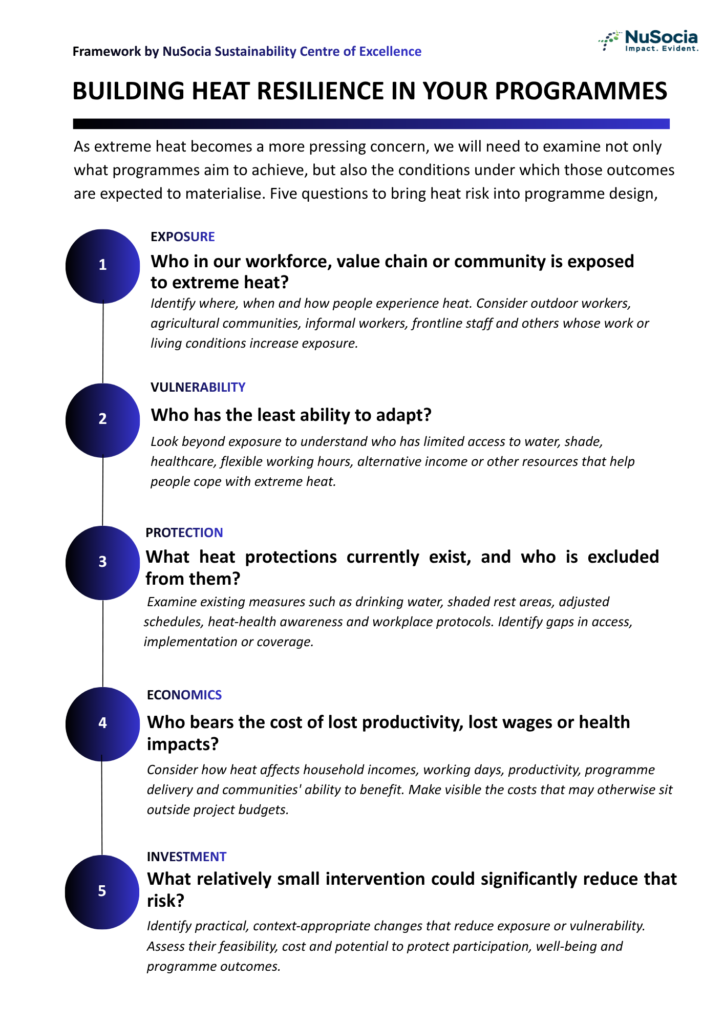
Exposure and Vulnerability establish who is at risk and why. Protection tests whether existing safeguards actually reach them. Economics makes visible the lost wages, working days and weaker outcomes that otherwise sit outside project budgets, turning heat from a welfare concern into a question of programme performance. Investment then focuses attention on relatively small, context-appropriate changes, such as drinking water, shaded rest areas or adjusted schedules, that protect both people and outcomes.
From accepted condition to managed risk
Sport has already shown that heat can be managed: with the right protocols, a match can pause without anyone losing out. The people our programmes serve deserve the same foresight. Funders and implementers who start asking these five questions now will be better placed to protect participants, safeguard their investments and deliver the outcomes they set out to achieve, however hot the summers become.
Reach out to research@nusocia.com to receive the full framework and how to use it.