
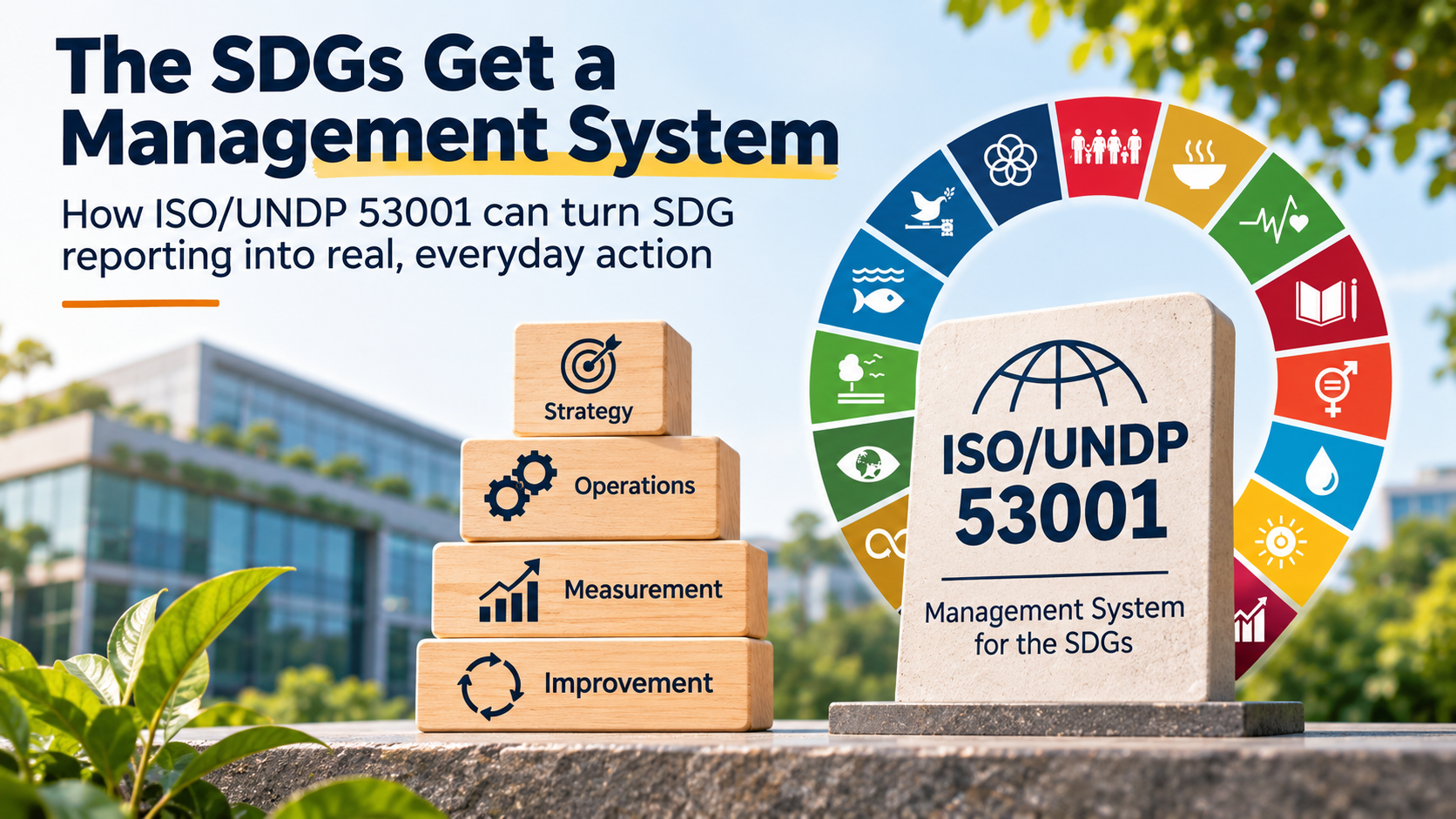
For most companies, the SDGs appear in two documents: the CSR annual report and the ESG or sustainability disclosure. The goals give a programme portfolio or a set of disclosures a globally recognised frame, and mapping activities against them has become standard practice.
These two documents have something in common. The CSR report exists because CSR spending and reporting are mandated. The ESG disclosure exists because regulators and investors now ask for it. The SDGs come in solely as the development framework rather than a starting point. Either way, both reports arrive through compliance.
That is worth saying plainly, and it doesn’t need to be said as a complaint. It is how most important norms have entered mainstream business. What has been missing for the SDGs is the operational machinery that usually comes with compliance. On 28 September 2026, the International Organization for Standardization and UNDP launched something that may rectify that.
The Context: Where the SDGs Live Now
ISO Secretary-General Sergio Mujica put the starting point simply: “The SDGs have provided a shared global vision for a decade.” The difficulty has been the step after vision. ISO’s own announcement says that many organisations have embraced the SDGs, but turning that ambition into consistent action has remained a significant challenge.
In India, the challenge has a recognisable shape. CSR is mandated, structured and housed in its own function, with its own committee, Schedule VII categories and implementation partners. SDG language entered CSR reporting because it gave programme portfolios a globally legible frame. Sustainability disclosure grew in parallel through BRSR, and there the SDGs became one of several ways to show that environmental and social risks were being considered.
In both cases, the requirement was to report, not to manage. Companies were told to spend, disclose and describe. They were not given a common method for deciding which goals mattered to them, setting objectives, building those objectives into operations and checking whether anything moved. Without a method, mapping became the default. It answers the reporting requirement well, but it is not designed to change how decisions get made inside the organisation.
The Approach: Why a Management System Standard Matters
ISO/UNDP 53001, Management systems for the United Nations Sustainable Development Goals (SDGs) – Requirements, was launched at the ISO Annual Meeting in Paris. Both ISO and UNDP describe it as the world’s first international standard for managing an organisation’s contribution to the SDGs.
The most important word in its title is “requirements”. ISO/UNDP 53001 is a requirements-based management system standard. That puts it in the same family as ISO 9001 for quality management and ISO 14001 for environmental management, and it is designed to integrate with both. It gives organisations a structured way to:
- identify which SDG priorities are relevant to them
- set objectives against those priorities
- build those objectives into existing processes, rather than run them as a parallel programme
- measure performance over time and improve continually
Because it is written as requirements, it gives organisations a consistent basis for demonstrating that their approach meets a defined bar. That is what has been missing from the CSR and ESG routes. Disclosure frameworks ask what you report. A management system standard asks how you run the organisation, and it gives you the method for doing so.
This is why the standard should make compliance easier, not heavier. Quality and environmental management systems are already familiar territory for many Indian companies, especially those in manufacturing and export supply chains. They have documentation habits, internal audit cycles and management review routines. A standard that sits on that machinery lets an organisation manage its SDG contribution with tools it already knows, instead of building a separate sustainability apparatus from scratch. ISO notes that by building on existing processes, this standard can reduce duplication and give organisations a more coherent approach to risks, commitments and strategic objectives.
UNDP’s Marcos Neto described the aim as helping organisations “embed the SDGs into the way they operate, lead and govern.” The emphasis on governance matters. A CSR committee can own a set of programmes. It cannot, by itself, own the question of whether the business model is working for the goals or against them. A management system pushes that question towards the leadership table.
The Shift: The SDGs Leave the Development Sector
The SDGs have been everyone’s goals on paper and mostly the development sector’s goals in practice. The standard’s intended users show the change in direction. It is written for businesses, governments, educational institutions, civil society organisations and others, of any size, sector or geography. Danish Standards, which led the technical committee, said that designing for that range required extensive collaboration among experts worldwide to reach an internationally agreed set of requirements.
This is how global capability gets built. Standards spread through institutions the development sector rarely reaches directly. These include procurement departments, auditors, quality managers and supplier codes of conduct. ISO and UNDP have also said they will develop sector-specific guidance to connect global priorities with the realities of particular industries and markets. If that happens at any scale, a plant manager, a procurement lead or a CFO would encounter the SDGs through the same systems they already use for quality, safety and environmental performance.
For Indian companies, the more interesting effect may be internal. A management system that asks for SDG objectives to be built into core processes cuts across the usual separation between the CSR function and the business. It invites a harder conversation about whether CSR spending, ESG disclosure and operational decisions are telling the same story.
Nonprofits and implementation partners should note that civil society organisations are explicitly within scope. For the first time, the organisations that have long done SDG-aligned work have a common, auditable way of showing how they manage their own contribution, beyond describing their programmes.
The Learning
For a decade, the SDGs have entered most organisations through the narrow door of required reporting: the CSR report on one side and the ESG disclosure on the other. What was missing was a method that turned the requirement to report into a practice of managing.
ISO/UNDP 53001 offers that method, in a form that organisations already know how to use. It does not guarantee impact, and it will not replace the organisations that choose to go beyond what any standard asks. But labour protections and environmental safeguards spread when they moved into the space of rules, systems and audits. If the SDGs are going to become part of everyone’s plan, that space is where they need to be.
Sources
- ISO, “ISO and UNDP launch world’s first International Standard to advance action on the Sustainable Development Goals,” 28 September 2026. https://www.iso.org/news/2026/09/iso-undp-53001
- UNDP, “ISO and UNDP launch world’s first International Standard to advance action on the Sustainable Development Goals.” https://www.undp.org/press-releases/iso-and-undp-launch-worlds-first-international-standard-advance-action-sustainable-development-goals