
Introduction: Unlocking the Digital Frontier in Mental Healthcare
Digital mental health uses technology—mobile apps, tele-counseling helplines, decision-support tools and AI—to screen, treat and manage psychological care at scale. In India, mental health receives less than 2% of corporate social responsibility (CSR) capital despite accounting for nearly 20% of the disease burden. Healthcare CSR has clustered around physical infrastructure in industrial states such as Maharashtra, Tamil Nadu, Gujarat and Karnataka, leaving rural, tribal and aspirational districts neglected. This explainer answers the key strategic, financial, operational and regulatory questions CSR leaders face when funding digital mental health.
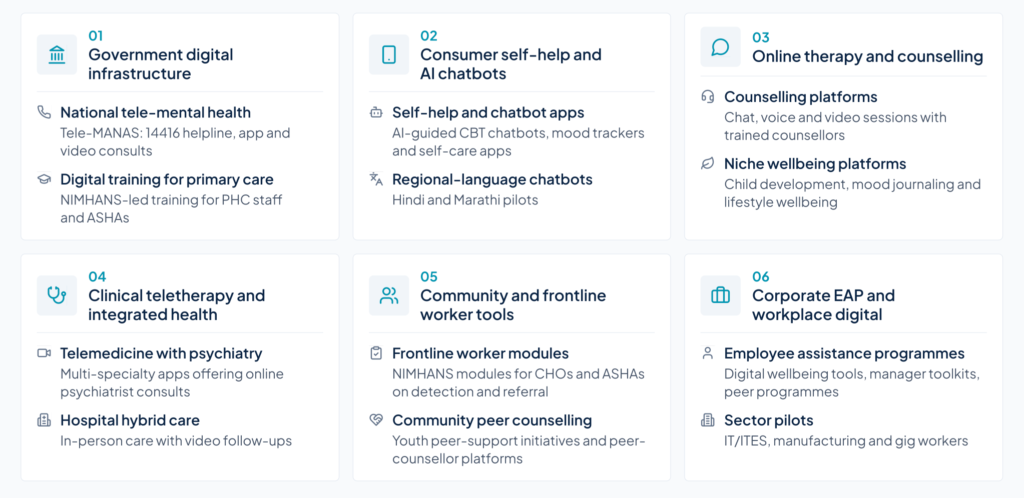
Figure 1. Existing digital mental health solutions
1. Is Funding Digital Mental Health Worth It? How Do We Justify It to Our Board?
About 10.6% of Indian adults live with a mental health condition, yet 70–92% receive no formal treatment (National Mental Health Survey).
Digital tools extend support into these areas without relying on scarce specialists. Mobile decision-support apps let Accredited Social Health Activists (ASHAs) and Community Health Officers (CHOs) screen, offer psychological first aid and coordinate referrals, while private digital access overcomes the stigma that deters up to 80% of people from face-to-face care. The result is a high social return on investment (SROI) that multiplies the reach of existing primary health networks.
2. How Do We Integrate Digital Mental Health with Existing Programmes Rather Than Running a Standalone Silo?
Standalone mental health programmes face high overheads, low retention and social resistance. Treating wellbeing as a cross-cutting multiplier—embedded in existing health, education and livelihoods work—is cheaper and more effective.
Health Sector Integration: Embed mobile electronic decision support systems (EDSS) into the routines of ASHAs and CHOs, linking records to Ayushman Bharat Health Account (ABHA) IDs, and connect rural sub-centers to psychiatrists through tele-psychiatry. Digital self-care apps such as SAMBHAV also reduce burnout among health workers themselves.
Education Sector Integration: Instead of one-off awareness workshops, whole-school models such as PRIDE (Goa, Delhi) and SEHER (Bihar) embed lay counselors, life-skills modules and digital wellbeing tracking into secondary schools, achieving sustained reductions in adolescent depression and anxiety.
Livelihoods Sector Integration: Self-Help Group (SHG) federations can train community leaders as mental health champions who link members to tele-counseling. The Live Love Laugh Foundation’s Koraput (Odisha) programme shows how combining psychiatric care with economic support restores functioning and income.
3. Which Delivery Model Is Most Investable: B2B2C, B2C Apps, Helplines, or Hybrid Community Platforms?
The five main models differ sharply in reach, cost, retention and clinical impact:
Hybrid Community Models (e.g., SMART Mental Health, Atmiyata): The most investable option. Frontline workers with offline-capable, vernacular tools reach deep into rural areas, and marginal costs fall from ₹745 per user at 100 beneficiaries to ₹7.45 at 10,000+ (AikyaMind). Trials show 74.7% depression remission versus 50.6% under standard care—but fewer than 25% of flagged complex cases reach psychiatric facilities without dedicated referral and travel support.
School-Based Models (e.g., PRIDE, SEHER): High leverage for youth portfolios at about ₹330 per student screened and ₹1,900 per case treated, with strong evidence on bullying, anxiety and depression. Lay counselors outperform teachers; out-of-school youth remain hard to reach.
Tele-Counselling and Helplines (e.g., Tele-MANAS, iCall): Immediate, anonymous, 24/7 multilingual crisis support. Co-funding government infrastructure is efficient—Tele-MANAS has handled over 3 million calls—but helplines need continuous supervision to prevent counselor burnout.
B2C Consumer Apps (e.g., Wysa, Amaha): Low CSR investability despite cheap urban distribution. Unguided apps have median 30-day retention of around 3% and attrition up to 91%, and rarely deliver sustained impact without human facilitation.
B2B2C and Workplace Platforms (e.g., YourDOST, MindPeers): Effective for workplace and campus wellness, but suited to CSR only when directed at contract labor, marginalized students or underserved vocational trainees.
4. What Partnership Structures Work Best to De-Risk Implementation Across Different Budget Tiers?
De-risking relies on coalitions of four roles: an implementing NGO (community trust), a health-tech vendor (low-bandwidth, secure software), a public health anchor (referrals and sustainability) and an academic evaluator (clinical oversight). Structure should match grant size:
Grants Under ₹2 Crore (Targeted Field Implementations): Avoid custom tech; co-fund proven models such as lay school counselors (PRIDE), tablet-equipped village volunteers (Atmiyata) or tele-counseling for low-resource colleges (Mana Maali).
Grants of ₹2 to ₹10 Crore (Regional Ecosystem Building): Form regional consortiums with MoUs linking primary health centers (PHCs) to district psychiatrists—for example, EDSS for ASHAs and doctors (SMART Mental Health), regional digital therapy hubs (Project Manas) or school-climate reform (SEHER).
Grants Above ₹10 Crore (National & State Infrastructure Anchor): Anchor systemic capacity: multi-state tele-mentoring such as NIMHANS Project ECHO (over 42,000 health staff trained), Tele-MANAS augmentation, or state-wide Ayushman Bharat Digital Mission (ABDM) integration.
5. How Do We Ensure Real Community Uptake and Sustained Use in Rural and Tier-2/3 India?
Rural and semi-urban uptake depends on designing around digital, social and cultural barriers.
Proven Scale-Friendly Design Patterns: Use stepped care, where a digital front door (helpline or health-worker app) triages and escalates severe cases; vernacular content (Tele-MANAS operates in 20 languages); and human support from trusted frontline workers who guide users and lead anti-stigma dialogue, as in ATMIYATA.
Documented Scale Blockers: App-only models fail where women’s phone ownership, data affordability and digital literacy are low; tools without offline mode stall in patchy networks; and screening without logistics support (transport, escorts, facility stigma) leaves referrals unattended.
6. How Do We Ensure Quality, Clinical Safety, Data Privacy, and Regulatory Compliance?
Most wellness apps in India sit outside CDSCO device oversight unless they make diagnostic or therapeutic claims under the Medical Devices Rules (2017). Tele-consultations follow the Telemedicine Practice Guidelines (2020), and user data falls under the Digital Personal Data Protection (DPDP) Act (2023). Funders should enforce four pillars across partners:
1. Quality and Safety Governance: Documented clinical rationale, clear intended use, suicide and self-harm escalation protocols, and adverse-event monitoring.
2. Privacy-by-Design Architecture: Data minimization, no third-party monetization, end-to-end encryption and minimal permissions to prevent identity leakage.
3. Ethical Compliance and Informed Consent: Vernacular or audio-visual consent that explains tool limitations and data handling.
4. Liability Clarity: Contracts assigning software liability to vendors and clinical responsibility to licensed providers.
7. What Measurable Outcomes Can We Track Across Grant Timelines Beyond “Awareness” and Downloads?
Move beyond downloads and attendance to a phased framework:
Phase 1: Early Adoption & Safety Minimums (0–3/6 Months): Onboarding completion, time to first screening or call, 4-week retention, high-risk cases flagged and crisis response times.
Phase 2: Care Linkage & Clinical Progress (6–12 Months): Follow-up and referral completion rates, time to treatment, and symptom change on validated tools (PHQ-9, GAD-7) alongside functional gains such as reduced absenteeism.
Phase 3: System Integration & Equity (12–24+ Months): Sustained clinical gains, equity across gender, caste, literacy and district, and integration into government health dashboards.
8. How Do We Navigate Government Alignment and Institutional Buy-In?
Sustainability depends on working through government channels rather than parallel private networks:
Tele-MANAS Integration: Fund state cells’ counselor training, specialized capacity and WhatsApp interfaces that route community screening into the national helpline.
Ayushman Bharat Digital Mission (ABDM) Compliance: Register facilities and professionals and issue ABHA IDs so records move across primary, secondary and tertiary care.
District Mental Health Programme (DMHP) Collaboration: Operates under MoUs with District Health Societies so cases flagged in villages reach DMHP psychiatrists for diagnosis, treatment and medication.
9. What Are the Sustainable Exit and Handover Strategies for CSR Funders?
Continuity after the grant must be designed in from day one:
Public System Absorption: Build open-source or licensable modules that state systems (e.g., the NHM NCD portal or ASHA apps) can absorb, with running costs moving to National Health Mission budgets once proven.
Institutional Capacity Building: Train existing CHOs, ASHAs and teachers (e.g., via NIMHANS ECHO) rather than paying temporary contractors; trained staff stay in the community.
Blended Financing and Social Impact Bonds: Use catalytic grants, risk-guarantee pools or outcome-based finance such as Development Impact Bonds, which repay capital once improvements are verified.
Academic References & Key Evidence Base
1. Gururaj, G., et al. (2016). National Mental Health Survey of India, 2015-16: Prevalence, patterns and outcomes. NIMHANS Publication No. 115.
2. Garg, K., et al. (2019). Mental health workforce in India: A secondary analysis of human resources and infrastructure. Indian Journal of Psychiatry, 61(2), 183-189.
3. India State-Level Disease Burden Initiative Mental Disorders Collaborators. (2020). The burden of mental disorders across the states of India: The Global Burden of Disease Study 1990–2017. The Lancet Psychiatry, 7(2), 148-161.
4. Maulik, P. K., et al. (2017). Evaluation of a innovative mental health intervention delivered by ASHA workers in rural India (SMART Mental Health): Cluster randomized trial. Journal of Medical Internet Research, 19(10), e363.
5. Patel, V., et al. (2017). The PRIDE intervention for adolescent mental health in Indian secondary schools: A cluster randomized controlled trial. The Lancet Child & Adolescent Health, 1(4), 276-287.
6. Joag, K., et al. (2020). ATMIYATA: A community-based intervention to mitigate mental distress and rural suicide in India. International Journal of Mental Health Systems, 14(1), 1-12.
7. Ministry of Health and Family Welfare, Government of India. (2022). National Tele Mental Health Programme (Tele-MANAS) Operational Guidelines.
8. Torous, J., et al. (2020). The digital health dropout dilemma: Meta-analysis of smartphone app engagement in mental health trials. World Psychiatry, 19(1), 88-89.
9. Ministry of Law and Justice, Government of India. (2023). The Digital Personal Data Protection Act, 2023 (Act No. 22 of 2023).