
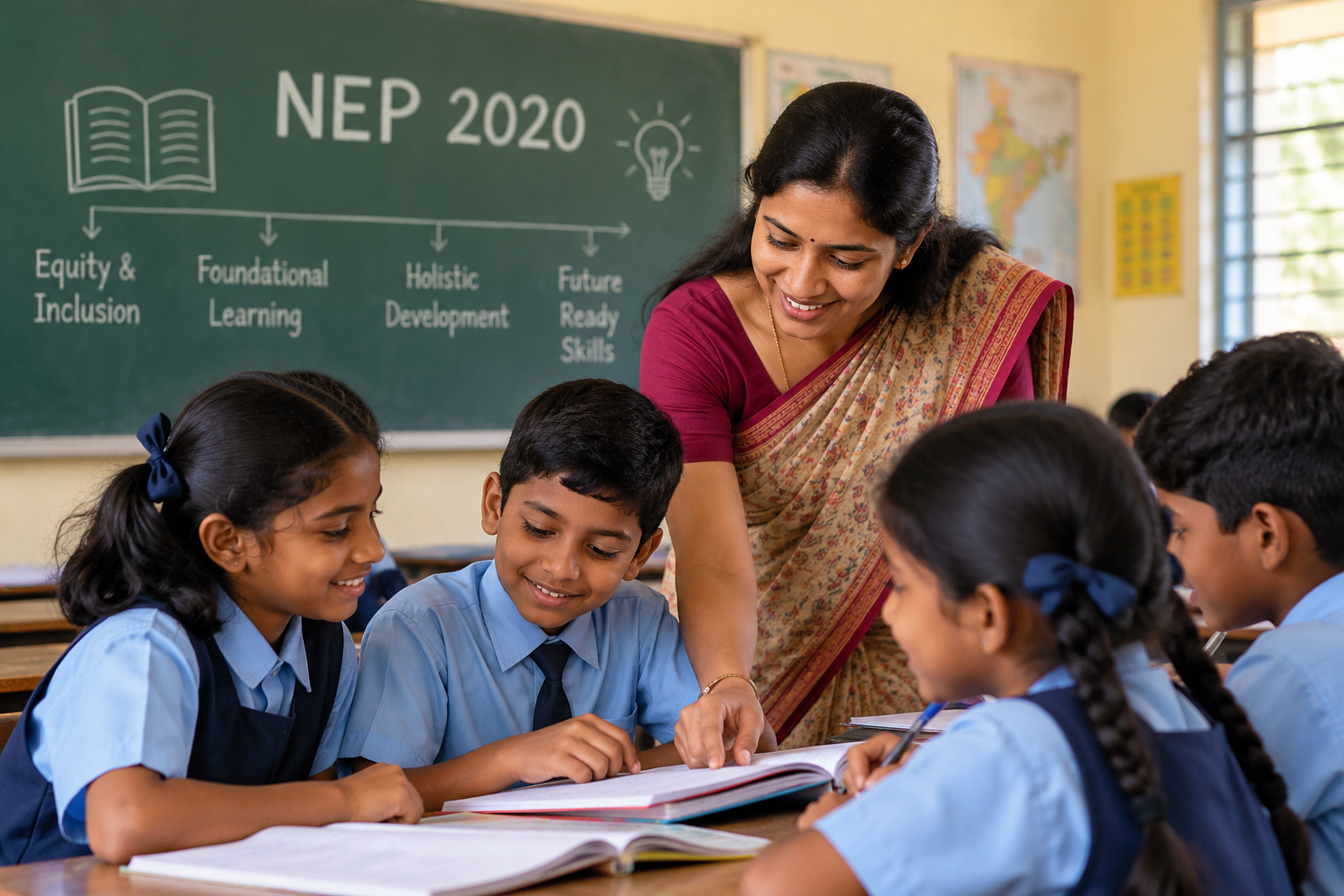
Six years on, few people in India’s school system question what the National Education Policy wants to achieve. The difficulty is pace. The policy that left flexibility for states for implementation is also demanding people who can turn it into steps a school can take, in an order it can manage. That work has largely fallen to organisations standing between the policy and the classroom.
The Voices in This Article
NuSocia put a common set of questions to three organisations that work inside state education systems, each seeing NEP 2020 from a different part of the system.
Adhyayan Quality Education Foundation helps state governments build school quality frameworks and school complexes: clusters of nearby schools that share resources and make decisions together. It has run complexes for about nine years in Goa, Tripura, Nagaland and Arunachal Pradesh. Kalyani Kumar spoke for Adhyayan. She also runs a low-income private school in Ranchi.
EduWeave Foundation, based in Delhi, works to strengthen the education system so every child has fair access to learning, and aims to reach 20 lakh children by 2027. Its Foundational Stage work focuses on how Anganwadis, pre-primary classrooms and early grades connect. Amita Kaushik shared EduWeave’s responses.
OpenLinks Foundation (OLF) runs Vinoba, an app that helps government school teachers find content, plan activities and engage students. Launched in 2022 in 3,638 schools in Pune, it is now used by about 2.3 lakh teachers across 41 districts. Sowmya Srinivasan, Partnerships Manager, shared OLF’s responses.
In a school in Nagaland, a teacher had spent months entering data into a government portal. Kalyani told her the portal was no longer in use. “Nobody told me,” the teacher said. A good part of her working time had gone into a system that led nowhere.
The moment is small, but it shows how a policy’s administrative demands can fragment on the ground. The teacher was not resisting reform. What she lacked was someone to tell her which demands still mattered, and what any of it was for.
All three organisations say teachers and field staff have taken up NEP’s language and approach, and want to focus on learning outcomes. What slows this progress is the work of turning intent into practice, and finding a way through the processes by which funds and resources reach schools.
The Context: A Policy Built to Be Adapted
NEP 2020 was deliberately open-ended. States began from very different points, so the policy let them choose where to start while pointing everyone in the same direction. That is its strength: states can respond to their own conditions rather than a single national template.
The same openness left many officials unsure. State and district teams worried about implementing it the wrong way and falling out of compliance. “There was no one fixed definition of what NEP implementation meant,” Kalyani says. What it meant in Goa differed so much from Tripura that even starting a conversation with a state government could be hard. A stream of supporting frameworks followed, and all of it arrived during the pandemic, when schools were still struggling to teach online.
Kalyani’s view is that the centre could have shown what implementation looked like where it was already happening. Goa had been running school hubs before NEP. During COVID, those hubs became places where teachers and school leaders shared resources and supported one another, a working version of what NEP later asked every state to build. Sowmya describes the policy as “strong on direction and light on implementation.”
What Moved, and Why
The policy has not stalled across the board. Foundational learning under NIPUN Bharat moved with urgency: funding, trained teachers, regular assessments and a 2026 target that gave states a reason to compete. The Balvatika years have been taken up in schools and Anganwadis, and vocational subjects from Grade 6 were adopted quickly. Where foundational learning has had regular practice and close attention, results followed. OLF reports that across 1,13,693 students in Palghar district, the share meeting the NIPUN benchmark rose from 16% to 57%.
Amita points to a quieter change that may matter more over time. Officers now ask about child development and about what children are actually doing in class. “The ideas underlying NEP 2020 have clearly entered the language of the system,” she says.
What these successes share is that someone had already broken the change into a target, a budget line, a sequence and a measure. Where that was done, states moved. Where it was not, they defaulted to compliance.
Challenge 1: Moving the System
“Awareness and willingness are not the same as readiness,” Amita says. The system knows what NEP asks for. It is still working out how, in what order and with what support.
For teachers, this comes down to a question Amita hears again and again: “What does this actually look like in my classroom?” Words like competencies, experiential learning and formative assessment have reached schools faster than the demonstrations, materials and mentoring that show what they mean on a Tuesday morning with forty children. Kalyani adds that teachers must still finish the syllabus, now alongside activities and teaching-learning materials, while public examinations have not changed. Their concern is fair: if the exam stays the same, time spent on activities can look like time taken from passing it.
Structural strain adds to this. Tripura has many single-teacher schools, teachers in remote districts are hard to recruit and keep, and many serve as teachers-in-charge, carrying a school leader’s responsibilities without a school leader’s recognition.
OLF names the area slowest to change: work that is not teaching. The policy says teachers should not be given tasks unrelated to teaching, yet they are still assigned election duty, the Special Intensive Revision of electoral rolls and other administrative work. A NIEPA study cited by OLF found that government school teachers spend only about 19% of their annual school hours teaching. The reason is practical. District and block offices are understaffed, and there is no one else to do it. Protecting teachers’ time means adding hands to take on the load.
Then there is the number of things asked at once. Kalyani has heard the same question from private school principals and government departments alike: why are we trying to do everything at the same time? Innovation weeks, cleanliness drives and campaigns run alongside the core reforms, each needing photographs as proof. When everything cannot be done well, doing everything visibly becomes the safe response. School quality reviews meant to start a cycle of improvement become a box to tick. “There is a journey beyond the review,” Kalyani says, and many states have not yet been shown what it looks like.
Teacher training shows the same pattern. The mandatory 50 hours of continuous professional development began with energy, but topics were not refreshed and rarely matched what teachers were struggling with. “How many times can you do the same training again and again?” Kalyani asks. She has watched teachers scroll through a two-hour module in ten minutes, pass the assessment and collect the certificate, and points to the decline in DIKSHA usage after 2021–22. The hours get completed. The learning mostly does not.
Challenge 2: Shifting Mindsets
When Kalyani’s school in Ranchi opened its Balvatika classes, parents’ first reactions had little to do with policy. Why was their child playing with clay instead of holding a pencil? Why was there no homework? “He has nothing to do at home,” one parent said.
Play-based learning is central to the Foundational Stage, and it may be the change that most directly challenges what families, and many educators, believe school is for. Amita cautions against reading this as parental resistance. Parents recognise learning by what schooling taught them to value: notebooks, alphabets, numbers, homework and marks. “Play itself remains an underrated idea in our society,” she says, “often seen as the opposite of learning.” Kalyani calls it a double-edged sword. Parents are asked to trust an approach without exams, with no earlier example to judge it by, and when one school moves to flexible assessment while another down the road keeps its exams, they compare. Reassurance and visible results take time.
The belief shapes institutions too. Families choose between an Anganwadi, a pre-primary section, a stand-alone preschool or a private school, and the setting that looks most like a conventional school can seem the best preparation for Grade 1. Enrolment decisions made by one family at a time can quietly undo what policy intends to achieve.
Educators carry their own version of the old model. Amita sees play-based learning sometimes reduced to a song, a story or an art activity. “Play-based does not mean unplanned,” she says. Behind an activity that feels like play to a child are deliberate choices about the skill being built, the materials, the questions and what to watch for. And if a child who has learned through play until six walks into a Grade 1 of textbooks and copying, the continuum “breaks precisely where it should become stronger.”
So what shifts a mindset? Amita’s answer is experience rather than explanation. Parents need to take part in what children do in class, so they can see the thinking inside “just play.” Learning has to be made visible in new ways: a child retelling a story, comparing quantities or sticking with a hard task helps assessment without marks make sense. And parents need a role of their own, not as substitute teachers but through conversation, storytelling, play and involving children in housework. “Policy philosophy therefore has to travel beyond the classroom.”
Kalyani’s experience in the northeast adds to this. Many parents there are farmers and plantation workers who trust the system to give their children a better future than their own. When Adhyayan invited them to school management committee meetings, they came in large numbers, including parents who were not committee members. They want their child in school, learning and staying out of trouble. Helping them understand what is happening in the classroom and why, Kalyani says, “is on us.”
Why Phasing Matters, and What We Can Do Now
Kalyani’s proposal is direct: “What states need right now are not ready-made solutions but a clearer road map.” She would pause the rollout and give states a year to build phased plans suited to their context, with the centre setting the outputs it expects by a given date. “We need a log frame for NEP,” she says, meaning a step-by-step plan with clear targets and feedback loops, so that parts that are not working, such as the current training model, are spotted and changed. Sowmya asks for the same: a clear statement of “what must be achieved, by whom and by when,” so districts can set sharp milestones. Amita says the 3–6 age group needs clearer guidance on roles, transitions and joint planning, but “greater clarity should not mean greater uniformity.” A tribal district, a crowded urban settlement and a state with many pre-primary sections in schools need different routes: “common developmental goals, clear institutional responsibilities and contextual pathways.”
OLF notes that NEP expects to be fully operational only in 2030–40, followed by a comprehensive review, so 2030 is a midpoint. Kalyani adds that implementation moves in waves rather than the way a company scales, and policies are meant to be amended along the way. The rush that schools feel in this process comes from how the policy is being rolled out, not from the policy itself.
The parent who wants homework, the teacher who needs to see where her data goes, the official afraid of underspending: each is acting on a long-held habit or belief, and those change slowly. Phasing does not lower ambition. It accepts that people change at their own pace, and that trying to change everything at once mostly produces compliance.
The Learning
None of this suggests NEP 2020 is failing. It has already changed how India thinks about the early years, about school quality and about who decides what a school works on. But flexibility has a cost. Someone has to turn broad intent into a sequence of steps, a framework that fits the state, a budget line spent with confidence, a classroom practice a teacher can picture. When that work is left incomplete, the openness meant to free people ends up freezing them, and they fall back on the response that always feels safe.
Amita puts it plainly: “NEP has changed the architecture. Its deeper legacy will depend on whether we change our perceptions, professional preparation, institutional relationships and everyday practices with it.”