
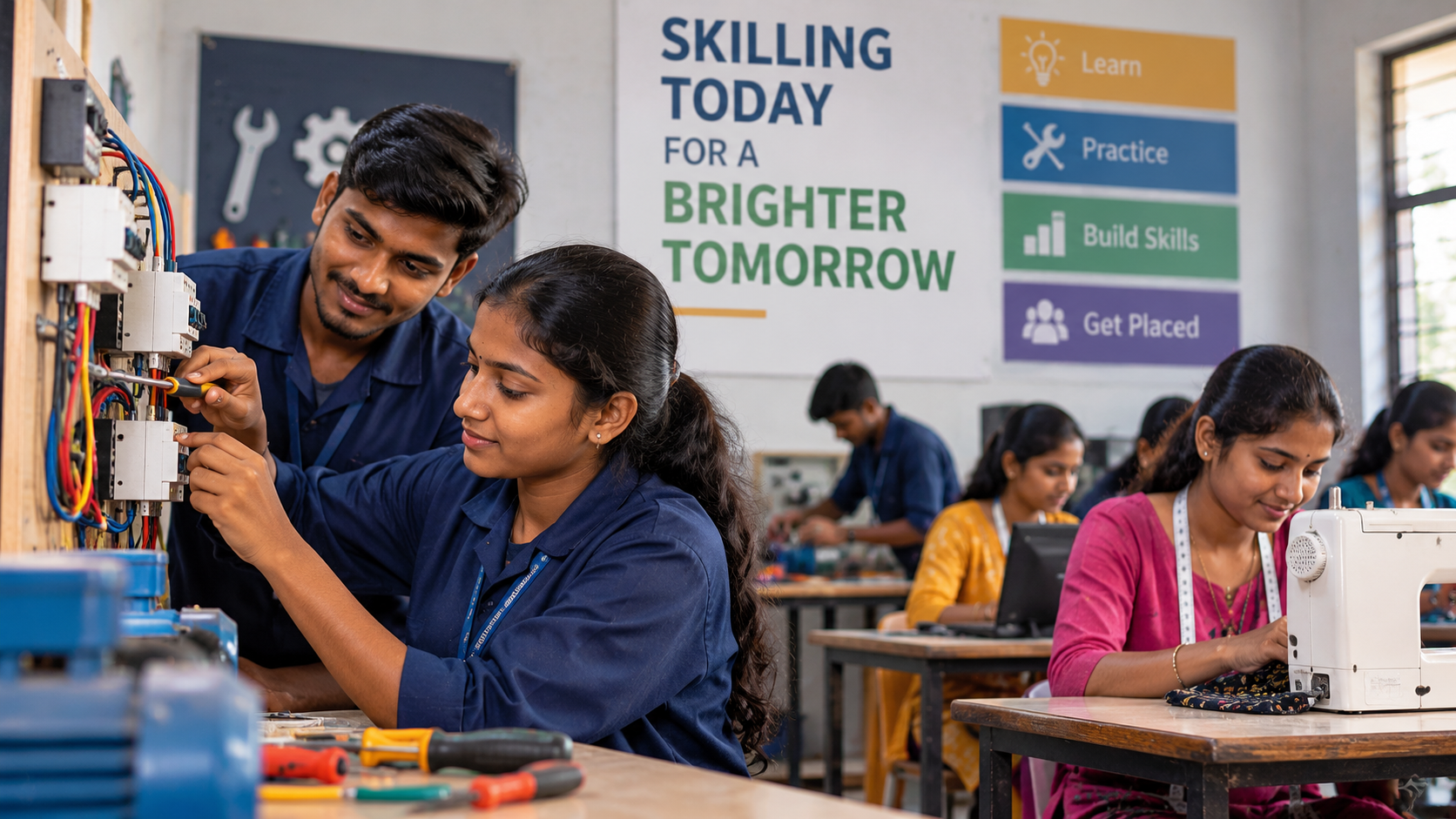
Skill development has become a key focus for corporates and organisations investing in training programmes for youth, women and vulnerable groups. These initiatives aim to equip participants with relevant skills to improve employability, generate income and strengthen livelihoods. This priority also aligns with the national agenda under the Skill India Mission, launched in 2015 to address skill gaps and enhance employment opportunities for India’s growing workforce.
Across the locations covered in our assessments, skill-development programmes often followed familiar patterns, with course choices shaped by both local market opportunities and gender norms. Women were more likely to be channelled towards beauty and boutique-related trades, while men were more commonly enrolled in technical courses such as electrical work, plumbing and computer operations. Yet, the journey from training to sustainable employment was rarely straightforward.
- When training meets a limited local market: Beauty-parlour training was frequently offered to women and girls, but completing the course did not always translate into an income opportunity. When several participants from the same village received similar training, the local market could quickly become saturated. At the same time, family restrictions often limited women’s ability to travel to nearby towns, where demand and employment opportunities were greater. (JKLC Needs Assessment, Rajasthan)
- When training does not translate into the intended job: Technical trades such as mechanic, electrician and plumbing were predominantly offered to men. Women who entered these traditionally male-dominated trades sometimes faced a different trajectory after placement. For instance, women trained as electricians were observed taking up administrative or reception roles rather than working in the trade for which they had been trained.
- More courses does not always mean a clearer career path: For some candidates, skill development became a process of accumulating courses rather than following a defined career pathway. Candidates sometimes enrolled in additional courses based on what was available or what they believed might improve their prospects. At one training centre, for example, candidates who had completed electrician training went on to enrol in solar-panel courses in the hope of accessing better opportunities. (TCL, Mithapur, Gujarat)
- The hidden cost of a job: A placement may look successful on paper, but the economics of taking up that job can tell a different story. Candidates often had to migrate for employment, and a salary of around ₹15,000 could be substantially reduced by the costs of rent, food and daily travel. For some, relocating was therefore not financially viable, leading them to seek opportunities closer to home, options that training centres were not always able to provide (JKLC Impact Assessment, Rajasthan)
- The challenge of staying in the job: Getting placed is only one part of the employment journey. Many candidates leave their jobs within the first six months. In some cases, this may be linked to the nature of the roles available, particularly where training is basic and placements are concentrated in apprentice or trainee positions. Others leave employment to pursue further education.
Taken together, these observations suggest that the effectiveness of a skill-development programme cannot be assessed by training completion and placement numbers alone. The more important question is what happens before and afterwards: whether the training matches aspirations and local demand, whether participants can access and afford the available jobs, and whether employment can be sustained over time.